Your gut is home to an enormous community of bacteria, fungi, viruses, and other microorganisms.
Together, they form the gut microbiome, an ecosystem involved in digestion, nutrient metabolism, immune function, and the production of compounds that can interact with the rest of the body.
What you eat helps shape that ecosystem.
A repetitive diet may repeatedly deliver the same nutrients and fibers to the same groups of microbes.
A more varied diet, on the other hand, can provide a wider collection of carbohydrates, polyphenols, fibers, and other compounds that different microorganisms are able to use.
This is why dietary diversity and the human gut microbiome have become an important area of nutrition research. Studies suggest that people eating a wider range of foods, particularly plant foods, can show differences in microbial diversity and bacterial abundance.
However, more diversity is not automatically better in every situation, and researchers are still working out which microbial patterns actually translate into better health.
The practical message is surprisingly simple: variety may matter almost as much as individual “superfoods.”
What Does Dietary Diversity Actually Mean?
Dietary diversity means regularly consuming foods from a broad range of food groups, ingredients, and plant sources rather than relying on the same handful of meals every day.
For the microbiome, variety is especially relevant because different microbes prefer different substrates.
The fibers in oats are not identical to those in lentils. Apples contain different plant compounds from broccoli. Nuts, beans, onions, berries, whole grains, herbs, and seeds each provide their own mix of fibers and phytochemicals.
In a human cross-sectional study involving 128 participants, people with higher dietary variety scores also had higher gut microbial alpha diversity and differences in the abundance of several bacterial groups.
Because the study was observational, it cannot prove that variety alone caused the differences.
Still, the finding fits a broader pattern showing that diet is one of the major environmental influences on gut microbial composition and function.
Plant Variety Gives Gut Microbes More to Work With
One of the easiest ways to understand dietary diversity is to think about plants.
Plant foods contain dozens of different forms of dietary fiber and resistant carbohydrates. Humans cannot completely digest many of these compounds in the small intestine, so they travel farther through the digestive tract and become fuel for intestinal microbes.
The American Gut Project found differences in microbial taxa between participants who reported eating fewer than 10 types of plants per week and those eating more than 30.
The study was citizen-science and observational, so the popular “30 plants per week” idea should not be treated as a strict medical target.
It is better understood as a practical reminder to diversify plant intake.
Vegetables and fruit count, but so do legumes, nuts, seeds, whole grains, herbs, and spices.
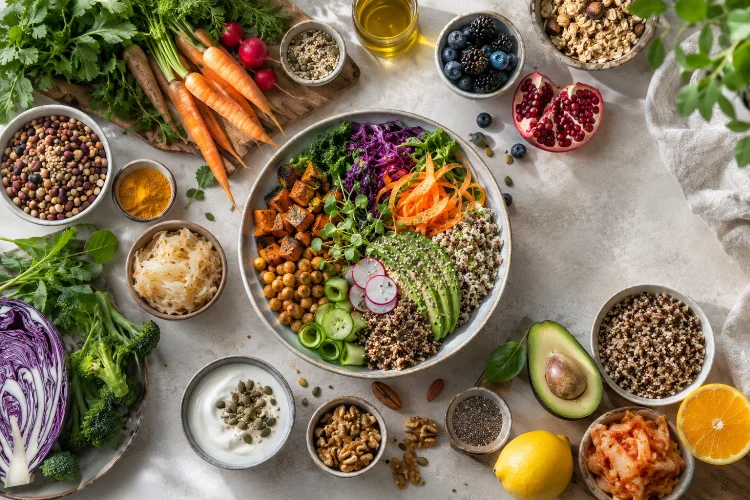
Someone eating oats, chickpeas, walnuts, spinach, tomatoes, apples, lentils, garlic, berries, and pumpkin seeds is feeding their microbiome a much wider range of substrates than someone eating the same refined cereal and sandwich every day.
Fiber Diversity May Matter More Than Fiber Alone
Most people have heard that fiber is good for gut health. The story is more complicated than simply hitting one daily number.
Different fibers have different physical structures, and different bacterial species possess different enzymes for breaking them down.
A systematic review and meta-analysis of 64 trials involving 2,099 healthy adults found that fiber interventions increased the abundance of Bifidobacterium and Lactobacillus species and modestly increased fecal butyrate.
Interestingly, the interventions did not consistently increase overall microbial alpha diversity.
That finding is important because it shows that a healthier microbiome is not simply one with the highest possible diversity score.
Fiber can change what microbes are doing even without dramatically changing the number of species present.
For everyday eating, this supports rotating fiber sources instead of depending on one food. Try mixing whole grains, vegetables, legumes, nuts, seeds, and fruit across the week rather than assuming a single high-fiber breakfast covers everything.
Gut Microbes Turn Food Into Useful Metabolites
Gut bacteria do more than simply live on undigested food.
When certain microbes ferment dietary fibers, they produce compounds known as short-chain fatty acids, or SCFAs. These include acetate, propionate, and butyrate.
Butyrate is particularly interesting because cells lining the colon can use it as an energy source. SCFAs are also involved in signalling pathways linked to intestinal barrier function, immune activity, and metabolism.
This is one reason dietary diversity may affect more than just the list of bacteria found in a stool sample.
Different foods can change microbial metabolic activity.
A varied supply of fermentable carbohydrates potentially supports a broader range of microbial pathways. In other words, what the microbiome does may be just as important as which microorganisms are present.
That distinction is easy to overlook when discussions focus only on “good bacteria.”
Fermented Foods Add Another Layer of Diversity
Fiber feeds existing gut microbes, while fermented foods can introduce microbial organisms and fermentation products from food itself.
Examples include yogurt, kefir, kimchi, sauerkraut, and some fermented vegetables.
In a 17-week randomized study of healthy adults, researchers compared a high-fiber diet with a diet rich in fermented foods. The fermented-food group showed a gradual increase in microbiome diversity along with reductions in several inflammatory markers.
The high-fiber group increased microbial carbohydrate-degrading capacity, but overall diversity remained relatively stable.
This does not mean fermented foods are automatically superior to fiber.
In fact, newer studies have shown that individual fermented foods do not always increase overall microbial diversity.
A sauerkraut intervention, for example, changed some bacterial species but did not suggest that every fermented food produces a dramatic microbiome transformation.
The takeaway is that both fiber-rich plants and fermented foods may support the microbiome through different mechanisms.
More Microbial Diversity Is Not Always Automatically Better
“More diversity equals healthier” is one of the most common oversimplifications in microbiome discussions.
Microbial diversity can be useful as an ecological measurement, and lower diversity has been observed in several disease states. But diversity by itself does not tell researchers whether every organism present is helpful, harmless, or potentially problematic.
Two people can also have very different gut microbiomes while both being healthy.
Age, geography, medication use, genetics, environment, long-term diet, physical activity, and many other factors influence microbial communities.
Modern reviews emphasize that human microbiomes vary substantially between individuals and that interpreting health from a single microbial metric remains difficult.
So the goal should not be to collect as many bacterial species as possible.
A more useful goal is supporting a stable and functionally capable microbial ecosystem with a diet that provides a wide variety of substrates.
That is a much more realistic view of gut health.
Highly Repetitive Diets May Narrow Microbial Opportunities
Consider someone who eats almost exactly the same foods every day: white bread, processed meat, refined cereal, a small number of vegetables, and very little fruit or legumes.
Even if the calorie and protein intake looks reasonable, the microbiome receives a relatively narrow selection of fermentable compounds.
A more diverse diet exposes microbes to different fibers and plant chemicals.
Reviews of diet-microbiome research consistently find that dietary patterns can alter microbial composition and metabolic function, although individual responses differ substantially.
Long-term dietary habits may also be more influential than a brief “microbiome reset” lasting only a few days.
This is why suddenly drinking one probiotic product is unlikely to compensate for an otherwise repetative diet.
The microbiome responds to patterns, not marketing slogans.
How to Build More Dietary Diversity Without Overcomplicating It
Improving variety does not require buying exotic superfoods or completely redesigning every meal.
Start with foods you already eat and create small rotations.
If breakfast is normally oatmeal, alternate the toppings between blueberries, banana, chia seeds, walnuts, pumpkin seeds, and different fruits. If rice is a dinner staple, occasionally replace part of it with lentils, barley, beans, or another whole grain.
A salad can become more diverse by combining several vegetables, herbs, seeds, and legumes instead of only lettuce and tomato.
Frozen vegetables count. Canned beans count. Herbs and spices can add additional plant compounds without making meals expensive.
The goal is not perfection or reaching a magic number every single week.
Increase diversity gradually, especially if your current diet is low in fiber. A sudden jump from very little fiber to huge amounts can cause bloating and discomfort while the digestive system adjusts.
Consistancy matters more than chasing an impressive one-week plant count.
Dietary diversity can influence the human gut microbiome by exposing intestinal microbes to a wider range of fibers, resistant carbohydrates, plant compounds, and fermented foods.
Research suggests that greater food variety is associated with differences in microbial diversity and bacterial abundance, while specific fibers can influence beneficial organisms and the production of metabolites such as short-chain fatty acids.
Fermented foods may provide another route for changing microbial activity, although responses vary between people.
The key is not to chase one “perfect” microbiome or obsess over a single probiotic food.
Instead, build diversity into your normal routine. Rotate vegetables, fruits, legumes, grains, nuts, seeds, herbs, and fermented foods when appropriate. Start with a few additional plant foods each week and gradually expand from there.
A more varied plate gives your gut ecosystem more opportunities to stay adaptable.