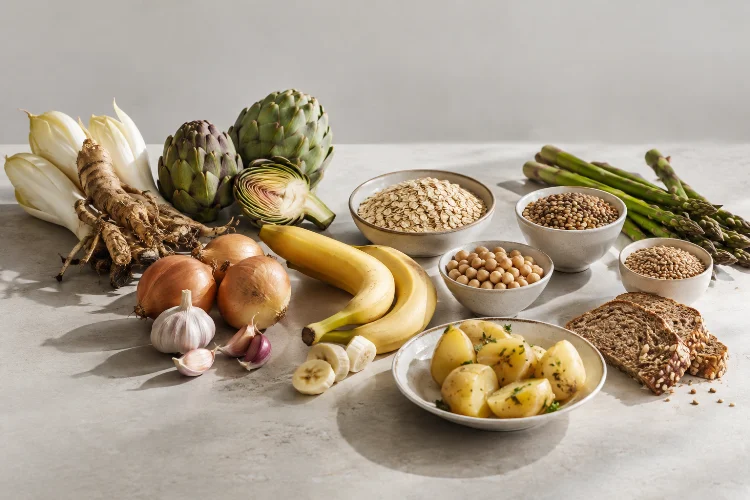
It is easy to talk about dietary fiber as if it were one single nutrient. In reality, fibers come in many different chemical structures, and your gut microbes definitely notice the difference.
Some fibers pass through the digestive tract with limited microbial fermentation. Others become valuable fuel for specific bacterial groups living in the colon.
Certain Bifidobacterium species may thrive when exposed to inulin or galacto-oligosaccharides, while bacteria such as Ruminococcus bromii are particularly skilled at breaking down resistant starch.
This is where different prebiotic fibres and gut microbial species become interesting.
A prebiotic is not simply any type of fiber. The scientific definition describes a prebiotic as a substance selectively used by host microorganisms that produces a health benefit.
Because microbes differ in the enzymes they possess, changing the type of fermentable carbohydrate you eat can effectively change which organisms receive the best food supply.
The result is a surprisingly dynamic microbial ecosystem shaped partly by what reaches your colon.
Not Every Dietary Fibre Is a Prebiotic
The words “fiber” and “prebiotic” are often used interchangeably, but they are not identical.
Dietary fiber is a broad nutritional category covering many carbohydrates that resist digestion in the small intestine.
Prebiotics have a more specific requirement: microorganisms must selectively use the substance, and that microbial activity must be linked with a demonstrated health benefit.
Why chemical structure matters
Imagine gut bacteria as workers carrying different sets of tools.
One bacterial species may possess enzymes capable of breaking the bonds in inulin, while another is better equipped to attack resistant starch.
Other organisms may depend on fermentation products created by those first bacteria instead of directly consuming the original fiber.
This helps explain why eating five grams of one fermentable fiber does not necessarily produce the same microbial responce as eating five grams of another.
The microbiome is not simply reacting to “fiber.” It is reacting to specific molecular structures.
Inulin and FOS Strongly Favor Bifidobacteria
Inulin and fructo-oligosaccharides, or FOS, belong to a family known as inulin-type fructans.
They occur naturally in foods such as onions, garlic, chicory root, asparagus, wheat, and Jerusalem artichokes, although purified versions are also commonly added to foods and supplements.
One of their most consistent effects is bifidogenesis – an increase in bacteria belonging to the genus Bifidobacterium.
A systematic review and meta-analysis covering 50 trials and 2,525 participants found that chicory-derived inulin-type fructans consumed at around 3–20 grams per day significantly increased Bifidobacterium abundance.
Another review of human studies found increases not only in Bifidobacterium but also, in some studies, in organisms such as Faecalibacterium prausnitzii and Lactobacillus.
That does not mean inulin will transform everyone’s microbiome in exactly the same way.
Habitual diet can modify the response. In one controlled study, participants with different baseline fiber intakes showed somewhat different microbial changes after consuming an inulin-type fructan.
GOS Gives Bifidobacteria Another Selective Advantage
Galacto-oligosaccharides, usually shortened to GOS, are another well-studied prebiotic.
They are structurally different from inulin-type fructans, but Bifidobacterium species are also particularly capable of utilizing them.
A randomized trial in healthy women found that only three weeks of consuming relatively low GOS doses – 1.3 or 2 grams per day – significantly increased the relative abundance of Bifidobacterium. The higher dose also produced a measurable shift in overall microbiota composition.
Earlier human trials found similar dose-related bifidogenic effects.
But even within the genus Bifidobacterium, responses can differ at the species level.
One study examining a combination containing GOS reported an increase in Bifidobacterium longum, illustrating how specific nutritional environments may favor particular microbial members rather than increasing every bifidobacterial species equally.
That is an important detail. Gut microbiome research is gradually moving beyond asking “Are bifidobacteria higher?” toward asking which species changed and what are they doing?
Resistant Starch Feeds a Very Different Microbial Network
Resistant starch behaves differently from ordinary digestible starch.
Instead of being completely broken down into glucose in the small intestine, some resistant starch reaches the colon, where bacteria can ferment it.
One species plays a particularly interesting role: Ruminococcus bromii.
Research has identified R. bromii as a keystone organism for degrading several forms of resistant starch. It can break down starch structures that many other gut bacteria struggle to access, effectively opening the food source for other organisms.
Human feeding studies have also shown that different resistant starches can produce very different microbial responses.
In one crossover study, resistant starch type 2 increased Ruminococcus bromii and Eubacterium rectale, while resistant starch type 4 produced larger increases in organisms including Bifidobacterium adolescentis and Parabacteroides distasonis.
So even foods carrying the label “resistant starch” cannot always be expected to behave identically.
Their physical and chemical structures matter.
Cross-Feeding Turns One Fibre Into Food for Several Species
One of the coolest parts of gut microbiology is something called cross-feeding.
A bacterial species does not always need to digest the original prebiotic itself to benefit from it.
Suppose Ruminococcus bromii begins breaking resistant starch into smaller molecules. Other bacteria can then use those products and produce additional metabolites, including short-chain fatty acids such as butyrate.
This creates a microbial food chain.
A study involving 174 healthy adults compared resistant potato starch, resistant maize starch, and chicory inulin. Potato resistant starch produced the largest increase in total short-chain fatty acids in that experiment.
Higher butyrate responses were associated particularly with increases in organisms such as Ruminococcus bromii alongside the presence of the butyrate producer Eubacterium rectale.
This shows why microbial changes should not always be interpreted one species at a time.
One organism may perform the first stage of fermantation while another completes the metabolic job.
Arabinoxylan Oligosaccharides Target Another Fermentation Pathway
Arabinoxylans are plant cell-wall carbohydrates found particularly in cereal grains such as wheat and rye.
When these carbohydrates are broken into shorter chains, they can form arabinoxylan oligosaccharides, commonly called AXOS.
Human trials suggest AXOS can produce another distinct prebiotic response.
In a randomized crossover trial, healthy adults consuming 10 grams per day of an AXOS-rich wheat bran extract experienced increased fecal Bifidobacterium, higher short-chain fatty acid concentrations, and lower fecal pH—signs of increased carbohydrate fermentation in the colon.
A longer 12-week AXOS trial also reported increased Bifidobacterium. Interestingly, microbial alpha diversity decreased rather than increased.
That finding highlights an important microbiome lesson: greater diversity is not automatically the same thing as a better response.
A prebiotic can selectively enrich particular organisms while reducing a mathematical measure of overall community diversity.
Your Starting Microbiome Changes the Response
Give two people exactly the same prebiotic and their microbiomes may react differently.
Why?
Their starting microbial communities are already different.
If someone has plenty of bacteria capable of degrading a particular fiber, that substrate may be rapidly fermented. Someone lacking those organisms may show a weaker response.
Resistant starch research demonstrates this clearly. In one study, people who showed larger butyrate responses tended to experience increases in resistant-starch degraders such as Bifidobacterium adolescentis or Ruminococcus bromii.
Participants whose microbiota did not show those increases had much smaller changes in butyrate.
GOS studies also show responders and non-responders, with baseline microbiota composition appearing to influence the result.
This is one reason microbiome nutrition is moving toward a more personalized model.
The “best” prebiotic may eventually depend partly on which microbial species an indvidual already carries.
Is Mixing Different Prebiotic Fibres Better?
Because different microbes prefer different substrates, eating a range of fermentable fibers makes biological sense.
That does not necessarily mean buying a supplement containing twelve different powders.
Whole foods naturally provide variety.
Oats, barley, legumes, onions, garlic, bananas, whole grains, cooked-and-cooled starches, vegetables, nuts, and seeds expose intestinal microbes to different carbohydrate structures.
Different substrates can support different stages of the microbial food web. Inulin may strongly encourage bifidobacteria, resistant starch can support starch-degrading communities, and AXOS can shift fermentation toward another group of microorganisms.
There is also no reason to increase every fermentable fiber at once.
Large sudden increases can cause gas, bloating, or bowel changes because gut microbes produce gases alongside other fermentation products. Increasing fiber gradually gives the digestive system time to adapt.
The aim should be dietary variety, not maximum fermentation at every meal.
Different prebiotic fibres can influence gut microbial species in remarkably specific ways.
Inulin and FOS consistently encourage Bifidobacterium, while GOS also provides a strong selective advantage to bifidobacterial populations.
Resistant starch can support organisms such as Ruminococcus bromii, Bifidobacterium adolescentis, and Eubacterium rectale, while AXOS creates yet another pattern of microbial fermantation.
The response, however, depends partly on the microbiome you already have.
Instead of searching for one perfect prebiotic, consider giving your gut microbes a wider menu. Eat a variety of whole grains, legumes, vegetables, fruits, nuts, seeds, and resistant-starch-containing foods, increasing fiber gradually.
Microbiome health may be less about feeding every bacterium equally and more about maintaining a flexible microbial community with access to many diffrent substrates.